
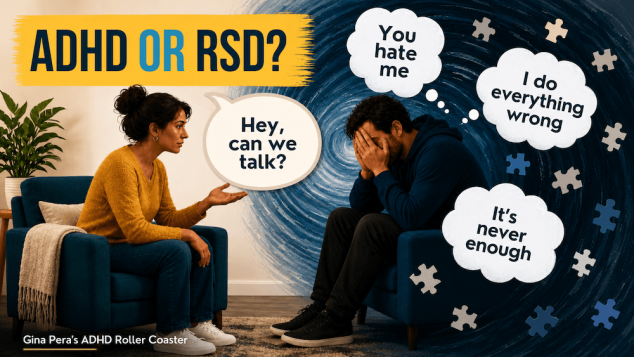
Search “Rejection Sensitive Dysphoria and ADHD,” and you’ll find a flood of articles describing intense emotional reactions to criticism or perceived rejection.
For many adults with ADHD—and for their partners—the description resonates immediately. And powerfully.
A simple comment or request lands as a sweeping indictment: You hate me. I always do everything wrong.
The partner who raised the issue ends up confused and perhaps apologizing. Eventually, they stop bringing things up at all because they feel they are walking on eggshells. In social media, you’ll see endless iterations of this phrase: “Once the RSD kicks in…”
To be clear: This pattern is real. It is common in adults with ADHD, especially those diagnosed later in life.
The problem is the label: Calling this pattern Rejection Sensitive Dysphoria (RSD) may actually obscure what is happening. And when the explanation is off, the solutions are, too.
In fact, the misinformation swirling around the Internet about RSD is worsening bad situations for many people. In this post, I offer a closer look at the phenomenon behind perceived RSD, especially paths to healing.
Emotional Dysregulation in ADHD Is Real
We know that individuals with ADHD often struggle with emotional regulation. Reactions can be quick, intense, and difficult to dial back once they begin. This is not a newly discovered phenomenon.
Psychologist Thomas Brown, a preeminent ADHD expert, describes one reason why:
“Sometimes the working memory impairments of ADHD allow a momentary emotion to become too strong; the person is flooded with one emotion and unable to attend to other emotions, facts, and memories relevant to that immediate situation.”
Working memory allows us to hold several pieces of information in mind at once. When working memory falters, a single emotion can dominate the mental landscape. Context drops away. Intentions disappear. The broader perspective that normally tempers emotion isn’t available.
In that moment, the feeling becomes the whole story. The only story.
When the Emotional System “Bottoms Out”
Another contributing factor is self-concept. This is bigger than “self-esteem.” Self-concept is essentially how you answer the question “Who am I?” based on your personal experiences and unique characteristics.
Many adults with unrecognized or poorly managed ADHD grow up with years—sometimes decades—of criticism, confusion, and unexplained struggles. They are corrected constantly (by others or themselves) for behaviors they cannot fully control: forgetting, interrupting, losing track of tasks, missing cues. Over time, those experiences shape how they see themselves.
Combine this with an unreliable memory that means not accurately remembering the things one did well, the successes achieved. Self-concept then remains only partially formed—and overly vulnerable to globally applying the latest mistake or disappointment to one’s entire life.
When self-concept is so fragile, so changeable, emotional reactions can bottom out quickly. There is nothing stable to hold onto. The mind flips into all-or-nothing thinking. Whatever happened in the last ten minutes becomes the entire narrative.
A small criticism can suddenly feel devastating—not because rejection has actually occurred, but because the person has little internal buffer against it. Even a neutral question (“Did you bring in the mail?”) can land as a criticism. That’s where things get really sticky.
Telling someone that they are not feeling what they are feeling isn’t helpful. Guiding someone through this phenomenon, and creating hope for positive change, is.
How This RSD-Like Pattern Develops
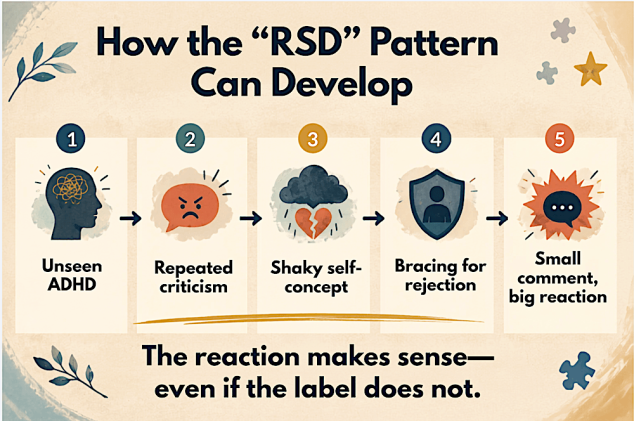
For many adults with ADHD, this sensitivity develops gradually.
First come years of unexplained difficulty. A person grows up not knowing they have ADHD—or not understanding what it actually means. Then come conclusions about the self and the world:
- People are harsh.
- I keep getting things wrong.
- Something must be wrong with me.
Eventually those experiences shape expectations. The person begins to brace for the next criticism, the next correction, the next sign of disappointment.
With experience as their guide, they stand ready to be hurt by the next perceived rejection because it has happened so often.
It is a painful way to move through life.
One woman described to me what happened when asking her husband if he’d paid an important bill. Within minutes, the conversation had shifted from the bill to his insisting that she thought he was incompetent and could never do anything right.
She found herself reassuring him instead of discussing the problem. “Eventually,” she said, “I just stopped bringing things up unless they were absolutely necessary.”
Did life improve for this couple? No, the situation continued to downspiral, and that’s exactly what we would expect: Tip-toeing around a problem isn’t solving a problem.
What Rejection-Sensitivity Research Shows
Research outside the ADHD field, in the traditional study of Rejection Sensitivity, helps illuminate the phenomenon.
 Psychologist Ozlem Ayduk’s work belongs to a well-established research tradition on rejection sensitivity and self-regulation. She also worked with Walter Mischel on the famous “Marshmallow Test.” This research on delayed gratification helped clarify how self-regulation early in life shapes adult outcomes. (I explain the relevance of this research in Adult ADHD-Focused Couple Therapy: Clinical Interventions)
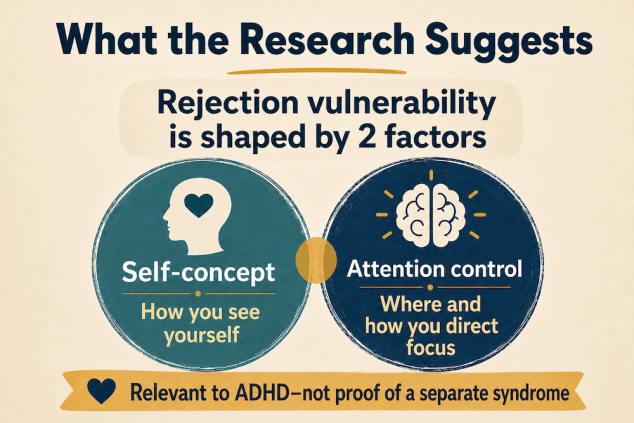
Ayduk and colleagues found that people with low self-esteem show stronger threat responses to rejection cues. In other words, rejection activates the brain’s defensive alarm system more strongly in those individuals.
But the researchers also found something encouraging: People with stronger attention control were less vulnerable to those reactions. In other words, vulnerability to rejection is shaped by two interacting factors:
- Self-concept
- The ability to regulate attention and impulse in the moment
That combination is highly relevant to ADHD. But it does not require a separate syndrome called RSD to explain it. To the contrary: It requires deepening one’s understanding of ADHD and of the “emotional baggage” so common to late-diagnosis ADHD.
Why the RSD Label Is Problematic
In fact, only recently has “rejection sensitivity” been repackaged and promoted in consumer ADHD media as “Rejection Sensitive Dysphoria.”
To emphasize: RSD does not appear in the DSM-5 ADHD criteria, and it is not recognized as a distinct syndrome in the main ADHD research literature.
Yes, the emotional experiences people describe are real. But turning them into one dramatic label can blur what is actually going on. Then, once the simple-sounding label takes hold, attention shifts away from the mechanisms that explain the behavior and offer true healing.
In fact, over decades, many researchers have argued that emotional dysregulation itself is a core feature of ADHD and should have a more central place in diagnosis. But it remains outside the formal ADHD symptom criteria in DSM-5 and DSM-5-TR, where it is treated as a common associated feature rather than a defining criterion.
Why the RSD Concept Spread So Quickly
Part of the answer is simple: The internet rewards sticky keywords.
Once the phrase “Rejection Sensitive Dysphoria” began circulating, it spread quickly through blogs, podcasts, videos, and social media posts. Search engines amplified it. Soon it was everywhere. Online popularity feeds on itself. For better or worse.
Moreover, when a term appears everywhere, it starts to feel authoritative. Even when the evidence behind it is thin. Even when it’s dominance online is more due to marketing than evidence.
Another factor is the Forer Effect: our tendency to recognize ourselves in broad, emotionally resonant descriptions. Statements like these feel deeply personal even though they apply to almost everyone:
- You want people to like and admire you.
- You sometimes doubt whether you made the right decision.
- You can appear confident outwardly while feeling insecure inside.
When a concept seems to explain a familiar emotional experience, it can feel strikingly accurate even if the explanation is incomplete.
Why the Term RSD Resonates So Strongly
There is another reason the term spread so quickly: It rings true.
It’s not surprising that many adults with ADHD immediately recognize the emotional experience being described. The phrase Rejection Sensitive Dysphoria captures something painful and familiar in only three words. Trouble is, we almost never hear that it is only part of the story.
The hard truth is this: Most people with ADHD are not receiving evidence-based ADHD treatment, particularly ADHD-specific psychotherapy. If therapy is provided at all, it is often general counseling—sometimes drawn from models such as attachment-based therapy or Emotionally Focused Therapy. These models were never designed for ADHD and have not been shown effective for it.
In fact, these approaches often take people backward rather than forward. Sometimes clients don’t care, however, because they finally feel validated. As a result, the mechanisms fueling these reactions rarely are discussed, much less revised.
Into that gap rushes a powerful, simple label: Rejection Sensitive Dysphoria.
Compress a complex phenomenon into three memorable words, attach it to a real emotional experience, and it spreads rapidly online.
How the RSD Narrative Was Marketed
It also matters how and why this language was popularized.
It came to us largely through a consumer ADHD publication operating in a pharmaceutical sponsorship environment. In that setting, readers were told not only that RSD is a common ADHD phenomenon, but also that medications such as guanfacine or clonidine could treat it.
I remember at the time hearing folks attending my local Adult ADHD group announce: “I’ve stopped taking a stimulant and am now treating my RSD with guanfacine.” I found it alarming. No legitimate ADHD expert would make such a claim. What was happening here?
On the face of it, telling readers that a generic medication like guanfacine helps with RSD can sound innocuous, even reassuring. But that apparent neutrality is exactly what makes the claim worth examining more carefully. A recommendation framed in generic terms can still support a branded market.
In this case, “guanfacine” did not just name a molecule. It pointed toward an ADHD treatment pathway in which the most visible branded product was Intuniv, the extended-release brand formulation.
So even a generic-sounding recommendation could help legitimize a broader treatment narrative from which a branded ADHD product stood to benefit.
The Medication Claims Around RSD
Claims that medications treat RSD continued to run ahead of the evidence. But few were questioning it.
Many other articles at commercial sites popped up, recommending medications such as guanfacine, clonidine, or even MAO inhibitors. Yet, these drugs were not developed or studied as treatments for the condition called Rejection Sensitive Dysphoria.
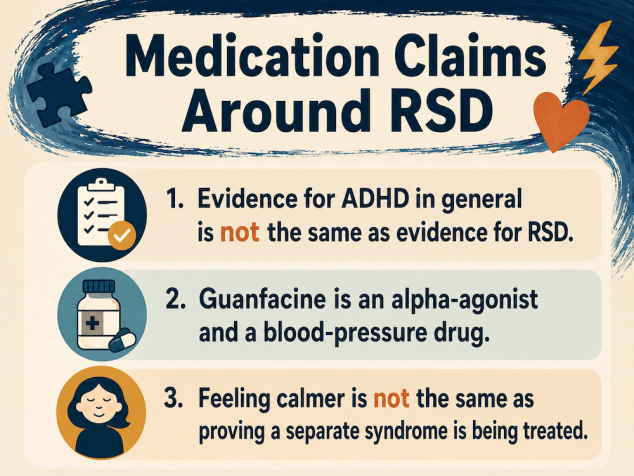
Some of these medications are used for other purposes, such as secondary ADHD treatments or antidepressants. But there is no established body of ADHD research showing that they treat a distinct RSD syndrome. Nor, in fact, do they treat ADHD symptoms.
Guanfacine, in particular, has not been directly shown to treat the specific pattern being labeled RSD. There is some research on guanfacine for ADHD in general, but that does not make it a first, second. or even third-line recommendation for ADHD. And, that is not the same as showing it treats RSD.
It also matters what kind of medication guanfacine is. Guanfacine is an alpha-agonist and an antihypertensive, meaning it lowers blood pressure. It can also be sedating.
So when people say it “works,” part of that effect may simply be that it dampens arousal and makes them feel calmer. That is not the same, however, as demonstrating that it treats a distinct syndrome. And it is not the same as treating ADHD symptoms.
Guanfacine and similar medications also carry real risks. In adults, it is not recommended without specialist input. So in a very real medical sense, framing these emotional reactions as a separate disorder requiring specialized medication can distract from better-supported approaches. They include:
- Appropriate ADHD medications for core symptoms
- Cognitive-behavioral therapy designed specifically for ADHD (Not standard CBT!)
- Education about how ADHD affects emotional regulation and self-perception
- Training in developing new mindsets, skills, and habits
Another huge risk: The person may believe they are “being treated for ADHD” when they are absolutely not. This cheats them out of their optimism and chance for a healthier, happier life.
When ADHD is treated well, individuals often gain more capacity to regulate attention, emotion, and perspective in the moment.
Why the RSD Label Can Keep You Stuck
In ADHD-challenged couples, the RSD narrative often creates another problem.
Partners of adults with ADHD are sometimes told that these emotional reactions are unavoidable and that the safest response is simply to avoid triggering rejection sensitivity. Over time, they begin to walk on eggshells.
Normal communication—raising concerns, discussing responsibilities, negotiating shared goals—becomes harder and harder.
Communication-processing problems can make this worse. The ADHD partner may miss part of what was said, misread tone, or latch onto one painful phrase while losing the larger context. (See Why Telling Your ADHD Partner “You’re Hurting Me” Isn’t Helping.)
In this way, a specific, entirely reasonable concern about chores or lateness lands as a judgment of the whole person. By the time the other partner tries to clarify, the emotional alarm has already gone off.
In other words, what some describe as RSD may actually reflect a mix of:
- Emotional dysregulation,
- Misinterpreted communication,
- Poor ADHD education in both partners,
- Years of expecting criticism, and
- Not knowing how to do things differently.
It also underscores the fact that many of these adults and couples are not getting the ADHD-specific help they need: paths out of “Rejection Sensitive Dysphoria” and into healthier, higher-functioning behavior.
Another couple I know had lived with the same pattern for years. After ADHD was finally recognized and treated, the husband became better able to notice the moment when a request started to feel like an attack.
Instead of immediately defending himself, he learned to say, “I know I’m reacting strongly. Give me a minute—I want to hear what you’re actually saying.” His wife no longer had to choose between swallowing the issue and triggering a blowup.

Understanding the Mechanisms Changes Everything
Again, the emotional reactions people describe when they talk about RSD are real. But the explanation and treatment circulating online often oversimplify what is happening.
Look more closely, and a clearer picture emerges:
- Working-memory limitations that magnify a single emotion
- Difficulty regulating emotional responses in the moment
- Years of criticism and misunderstanding that damage self-confidence
- Communication breakdowns that distort how messages are heard
These are not fixed character traits. They are understandable consequences of how ADHD affects the brain.
That is why the label matters.
When people are told they have a stand-alone syndrome called RSD, they can get stuck in the label itself. When individuals and couples understand what is actually happening, they gain something more useful than a dramatic label. They gain a practical roadmap for change.
Making Sense of the “RSD Phenomenon”
To explain the “pile-up” of symptoms, misinterpretations and poor coping responses, which is so common to late-diagnosis ADHD, check out this video from my Foundations training, part of Solving Your Adult ADHD Puzzle.
This has been the backbone of my work for years, because it explains so much.
As always, I welcome your comments and questions.
Gina Pera

18 thoughts on “ADHD and Rejection Sensitive Dysphoria: A Closer Look”
Hi Gina, I wonder if you have any thoughts on how to deal with these types of issues between parents and their young adult children with ADHD. My 24 year old son moved back home 3 months ago after a break up and it has been difficult to communicate expectations for sharing space again (not that communication was great before he moved out). I’m tired of walking on eggshells all the time while also resenting feeling used and abused. Help?
Hi Kelly,
I can start by being very clear about one thing: The issue isn’t about “communicating expectations”. You can be the worldwide Toastmasters’ champion, the best communicator in the world, and it won’t move the needle of poorly managed ADHD.
This is a major reason why couple therapy often fails for ADHD-challenged couples. The clinician assumes that improving communication is the goal. No, the goal is learning how to manage ADHD, as individuals and a couple.
I touch upon this theme here in “Why Telling Your ADHD Partner ‘You’re Hurting Me’ Isn’t Helping”
Yes, this is a parent and child situation, not a couple. But the same ideas apply.
You shouldn’t have to walk on eggshells in your own home. But I imagine that your son’s ADHD is not well-managed.
This is likely not his fault. Even people with ADHD who “seek professional help” are often failed. Therapists and prescribers, too, just aren’t trained to provide evidence-based treatment. So folks hobble along, believing that they tried, and that’s as good as it will get.
I encourage you to check out my online training curriculum. It will tell you what needs to happen, for your son to increase functioning in life (because I imagine the breakup had much to do with poorly managed ADHD) and for you to work with him without being a “nag” or an “enabler.”
I haven’t had time to edit the page and close out the sale. So you can still get the sales price.
But mainly look at each of the three “puzzle piece” pages, see the videos, get an idea for what you and he have been missing.
https://ginapera.adhdsuccesstraining.com/
good luck!
Gina
I apologize ahead of time for the length of this comment.
I have noticed that my girlfriend often feels as though I’m accusing her of being inadequate or unintelligent when bringing up things that hurt me, asking to double check something, and asking her about things she’s not well versed in.
She has expressed to me a similar experience to that of which you have written, a lifetime of people telling her that’s she not good enough and she should do better.
She is currently unmedicated and is not in any therapy due to financial constraints. Im currently tackling feelings of frustration and exhaustion at the current state of our relationship but I also have come to understand that she has been dealing with a lifetime of exhaustion and frustration due to being untreated and punished for her ADHD.
Some of the biggest issues we are currently facing is her emotional dysregulation, guilt and shame cycles, and my struggle to aid her and not accidentally put her down for things out of her control. Examples of this emotional dysregulation include being easily upset, screaming and or yelling when upset, consistent panic attacks varying from daily to weekly, easily stressed and will often cry when stressed, and occasional throwing of things when angry (not at me).
She has expressed that trying to hold back her anger feels impossible at times and that she is actively trying to manage her stress but it feels like climbing a mountain. I think she has made a lot of improvements with the frequency of these actions. Which I can only imagine how difficult that must have been to manage on her own but they still happen quit frequently (weekly).
A hard boundary of mine is not yelling at me or around me and not throwing things in my prescience. I’m unsure if these are unfair asks or if it’s inconsiderate for me to feel emotionally depleted by the situations I have listed. I want to be supportive and helpful to her but I have also realized that I sometimes feel as though I’m trying to avoid situations that would elicit such strong emotional responses from her which includes an actively developing aversion to discussing any issues I might have.
When I bring up problems she often goes into a guilt and shame cycle of feeling as though she’s a horrible person, she consistently states that she always messes everything up and it’s inevitable with her. I don’t want to cause her to feel this way but I also don’t want to neglect my own hurt.
I’m unsure if this is also an adhd characteristic but she is also a highly empathetic person and often takes on my feelings at times. When I cry she’s crying and is also sent into onset panic. I know and understand that this is from a place of love and concern but it often leaves me feeling as though I wasn’t properly comforted or I’m unable to stop being the “rock”.
I love her deeply and I think she is an absolutely amazing partner but I want to better understand her and support her, while also making sure I don’t dismiss my own feelings of hurt and frustration or exhaustion.
We have been together for the past five years and recently moved in together this year and under these circumstances I have realized just how much of an impact adhd has on her and our relationship and would like to further my education on the subject.
I unfortunately have fallen down the social media trap of listening to the wrong voices on this topic. I feel my wrongfully educated misconceptions on what she can and can’t do and what is and isn’t difficult for her has probably negatively impacted her.
I hope this is coherent so far but I suppose what I wanted to ask you is where do we go from here. Are my asks that I have previously listed to unreasonable? What is the first step to navigating these things when medication and therapy isn’t a readily available resource?
Dear Osiris,
Yes, you are absolutely coherent in painting a picture of what is happening in your relationship.
I appreciate the difficulty of this situation — for both of you.
It is not fair for either of you to continue with these patterns. The highest priority should be going to evaluation and medication treatment. It might not be as expensive as you think. There might be sliding-scale clinics. Her GP might be willing to give her a trial of Ritalin (most are familiar with that and even if it doesn’t end up being the best choice, it would be a start).
There are also various savings programs for the newer brand drugs.
Therapy is really, typically, not very useful for ADHD. In fact, it often ends up making things worse. Whether it’s individual or couple therapy, most clinicians just don’t know what they need to know. They might think they know ADHD – from visiting websites or even taking a continuing-education course. But that is not enough. And everything about clinical training can be the opposite of what’s needed with ADHD.
The therapy models shown effective for ADHD largely focus on “psychological education” — that is, ADHD and the ways in which this highly variable syndrome are affecting the individual and the couple. It focuses on revising old misinterpretations and poor coping responses, on healing dysfunctional patterns AND on learning new skills and habits.
I teach all of this in my online training, because I was just so tired of the mental health profession not stepping up. I also cover medication because we’re lacking skilled prescribers, too. Most of it is just careful process of elimination. Trying one medication at a low dose. increasing slowly, until side effects outweigh benefits, and then backing down a bit on the dosage. And of course, you want to focus on medication-sensitive targets. That is, understanding the difference between ADHD symptoms and the poor coping responses developed over a lifetime of living with unrecognized ADHD. You tackle each separately.
In other words, if you two want to try working things out, there are resources available for you.
And, in my long experience, this is what is needed to create positive change. Without really taking these symptoms and poor coping responses seriously, you both risk further exhaustion and emotional burnout.
You cannot be your partner’s treatment. Just as if she had poor eyesight for which she needed glasses, this is a physical condition. And it also has the “emotional baggage” of being diagnosed later in life. This requires serious consideration.
In other words, if you two are like many other couples, love and good intentions are not enough. It is likely very hard for you to take care of yourself while your partner’s ADHD symptoms, especially emotional dysregulation, wreak havoc with her ability to navigate life and her relationship day in and day out. This seldom ends well.
I encourage you to take care of yourself, to make some hard decisions about your future, and establish some ground rules. The first, in my opinion, should be taking charge of Adult ADHD and focusing on a happier, healthier life.
Good luck
Gina
I have been thinking about RSD for a long time. In my husbands case it’s often a reaction to feelings of inadequacy. I am not sure if this is RSD or something else entirely.
Sometimes there can be delayed RSD. For example: He felt inadequate in the morning chatting to other school dads about nice holidays or responsibilities. My husband does not earn very much money, I do all the admin and life planning, and he struggles to remember things like what our kids are studying. There could be a few points during the conversation where he realises he does have the same skills or attainments as most dads. He realises I (his wife) does most of the stuff these dads do, not him. It stews in his mind all day to the point where he needs to verbally attack someone about something that makes him feel powerful even for a few minutes. The emotional punching bag is usually me or one of the kids. It’s usually about something he twists into an issue that it isn’t or just a random nasty comment (he find one coffee cup on a nightstand and tell our son his bedroom is a complete mess, exaggerate the severity, call him lazy/dirty, yet all the whole ignoring the fact that our son has been working all day and has just got home, or helping around the house or is doing homework first). This often comes out of the blue and it’s hard to connect it with the RSD unless I was present in the earlier situation where he felt inadequate. I also notice my MIL does something similar.
Hi VM
Thanks for your comment. I find it so insightful, no doubt the result of careful observation over years. As you detail your perceptions, I think you can see why these behaviors don’t “come out of the blue” at all. They have been long-simmering, like a volcano, until the ability to retain it all “blows”.
This phenomenon can be intensified when a child at home also has ADHD. It is commonly referred to as “adding fuel to fire.”
This is what I am talking about…..poorly managed ADHD over the year can turn into a murky mix of symptoms, poor coping responses, and often a chronic sense of underachievement. Of feeling less than. It’s a hard way to go through life. And hard to live with in a mate.
I touch upon this theme in this post: https://adhdrollercoaster.org/why-telling-your-adhd-partner-youre-hurting-me-isnt-helping/
ADHD treatment cornerstones include:
1. Education in ADHD symptoms through the lifespan, helping the person connect the dots between symptoms and challenges since childhood. These can change appearances through developmental stages, but at core distractibility, inattention, and hyperactivity remain.
2. Education in the common patterns that result from ADHD going unrecognized and poorly managed. These might include poor coping responses such as avoidance, procrastination, and deflection. But they also include instances where the person is “in denial” of their challenges, because symptoms themselves can impair self-insight. There is a reason my first book included three chapters on “denial”, which can be both physiological and psychological.
3. Understanding of the common fallout as due to ADHD symptoms rather than low intelligence or effort — including lower educational attainment, difficulty remaining employed, and in general difficulty in being able to “show what they know”.
4. Education in new habits and skills to support Executive Functions (in short, getting things done and moving through the world in a way that reflects intentions rather than impulses). Actually learning these step by step, not being told to use a calendar and set alarms.
5. Optimizing medication and sleep to make all this more possible.
Most people with late-diagnosis ADHD are not helped with any of this, or are helped piecemeal and often in the wrong order.
I encourage you to check out my online system. It provides what we should be getting from prescribers and therapists—but only rarely are. Just check out the details for each major “puzzle piece” to get an idea of what you might have been missing. It might unlock some doors!
https://ginapera.adhdsuccesstraining.com/
best
Gina
Thanks for the insight. Explains a lot. From a somewhat frustrated and exhausted partner of an adhd older adult.
Thanks, Wayne. It IS exhausting. For everyone. A very hard way to live.
You might want to check out my ADHD Partner group. There is a men’s Zoom meeting, too. Because men with female ADHD Partners seldom find the understanding they deserve.
https://ginapera.adhdsuccesstraining.com/ginaperacommunity
take care and keep learning. It can help to keep you grounded amid chaos.
I’m wondering if you are referring to a webinar by X as one of your examples of popular media. If so, I would say that I found that to be actually a very good webinar and quite explanatory to clients (I am a psychologist). I don’t disagree that there are a lot of sources out there who do not have the proper background to be throwing out RSD as what’s going on. I also don’t disagree about the importance of not stopping with the cute acronym for what’s going on because tools, strategies and change are vital. However, I would just remind that the field of psychology and psychiatry has FOREVER used diagnosis as a short hand to explain a multitude of symptoms with the express notion that they should be appropriately addressed. As a psychologist, that is how I use RSD and I find it very helpful for clients to have a short hand way of talking about what’s going on. Of course, just having the label is far from enough but I do think it’s important to understand, as X pointed out, that what we are calling RSD (at least he and I) is bigger than just emotional dysregulation, memory issues and a history of feeling defensive because of letting people down or missing something. It can be felt on a physical level and it’s fairly automatic until/unless taking time and using CBT skills are used to stop the story.
I just wanted to say that it’s not necessarily bad to have the label. It’s what is done with it that makes the most difference. In my experience, if clients have an easy way to reference what’s going on they are more likely to talk about it which means they will then be more likely to find better strategies for overcoming it. I also do agree that mental health providers need to truly understand ADHD from not only a diagnostic perspective but also from a clinical perspective. And while studies aren’t there yet (there are some in process right now) linking guanfacine to reductions in what we are calling RSD behaviors, clinically we DO see that in many cases so I don’t think we should throw that baby out with the bathwater. Guanfacine isn’t sedating so much as it’s calming down the fight or flight response. Yes, it can create drowsiness when the body is acclimating to it but many clients are just fine taking it in the morning after accommodation. Wanting to calm down the fight or flight response isn’t any different than wanting to use stimulants to increase focus. Both are treating symptoms of ADHD. Both can be useful. Both need to be part of a wise approach to the whole person and a physician should be making sure they are appropriate for use in any given person.
Thank you for your comment. Please note that I have removed the link and name you provided. Citing popular consumer webinars and marketing-driven narratives illustrates the exact issue my article addresses.
The popularization of “RSD” as a distinct condition uniquely responsive to alpha-2 agonists was heavily driven through commercial media platforms rather than through independent, peer-reviewed clinical validation studies or randomized controlled trials.
From my vantage point, encountering large numbers of adults with ADHD and their loved ones for many years, I see the devastation this is creating. And I find it unconscionable.
In the article I acknowledged the utility of giving clients accessible language. Equating “RSD” with a legitimate diagnostic construct, however, is clinically problematic.
Valid diagnostic terms require rigorous operationalization, peer-reviewed construct validity, and proven discriminative power against established conditions (e.g., borderline personality traits, social anxiety, depression, or basic ADHD-driven emotional impulsivity).
When clinicians adopt unvalidated terms from secondary sources and webinars, it undermines diagnostic precision. We have a solid body of work indicating what “works” for ADHD. We don’t need to adopt narratives that benefit only a company’s bottom line.
The same applies to medication rationale. Off-label prescribing of alpha-2 agonists like guanfacine because they “calm fight-or-flight” does not establish a mechanistic or empirical link to a unique condition called “RSD.”
Physiological dampening is non-specific; it does not substitute for treating the executive dysregulation, memory deficits, and relational dynamics that drive these acute emotional episodes in the first place. The goal should always be to elevate the standard of ADHD care through validated science, rather than adopting marketing-driven nomenclature that risks confusing clients about the root causes of their struggles. And keeping them stuck. Prescribing guanfacine as the first treatment for ADHD happens all the time, and that is nothing sort of medical malpractice.
In fact, in many other ways, poor prescribing is the standard. Therapy that fails to implement the proven models for ADHD is, too. Without optimizing medication and sleep, without a deep and personalized psychoeducation, without instruction in supporting Executive Functions from the ground up, and without optimism and validation….the person and their loved ones are left to hobble along. Content that they are at least “less reactive.”
I want so much more for ADHD-challenged individuals and couples. They deserve better, and precious few are getting it.
Gina
Since Gina has it set up so that you can’t reply to her, I will reply to myself to respond to her answer to me.
Gina
With all due respect, I think you need to get a license to practice psychotherapy before you start telling people who have been doing it for decades how things actually work. You love to talk about how mental health providers don’t understand ADHD and then when you have one who is specialized you still want to patronize and tell the professional how therapy is done, how diagnosis is done, whether short hand to refer to exactly the cluster of other components is valid. I specifically addressed the reality that all of the different parts of what makes up RSD have to be individually addressed as well as the behavior as well as the dynamic the behavior creates within the couple.
Also maybe listen to the professional IN THE FIELD DOING THE WORK you love to disparage and discount. It has ALWAYS been the norm for medications to be used off label for areas that they do help improve while the science catches up to the clinical work. There are dozens and dozens of examples. People who have both done independent research and have practiced clinically understand that the science and data are driven by what’s going on clinically. We see it in the trenches first and then they create their hypotheses. The science is starting and it comes from what clinicians have been seeing help.
I really like your information. I ROUTINELY (as in every single couple with ADHD that I see) ask them to read your book because you have good information for them. By the way, even your book is a therapeutic short cut so that I can save time within my sessions actually diving into the WAY in which all the various ADHD behaviors are influencing them.
I have commented a couple times, with nuance and respect for all that you’ve contributed to the field and teaching even the professionals. However, what I’ve noticed is that you seem to have a need to be right above all else and even people who are every bit as legitimate in their expertise as you are told how wrong they are should they dare to disagree with you. That’s a shame. You are not always right. You are not a licensed clinician. You do not practice therapy and help the couples within the interactions in real time even though you have groups for the partners—it’s a whole different ball game when the couple is sitting in your office and you need to guide them through the issues you only describe but do not treat. We can all learn from each other but it requires a bit of humility and I don’t see that in you sadly.
Sonja,
Let’s get this out of the way: You state that I have “set it up” so that readers cannot respond to my comments. That is false. The evidence is that you have just responded to my comment.
All comments are held for moderation. That is stated on the comment form.
At any rate, your latest comment moves away from the substance of my article and into questions of credentials, status, and personality. I’m not going to engage at that level. My focus is on what we know helps Adult ADHD-challenged individuals and couples. Not my ego.
I have never claimed to be a licensed psychotherapist. I have, however, spent decades immersed in adult ADHD, working directly with ADHD-affected individuals, couples, clinicians, and researchers. I also co-authored the only evidence-based professional guide to ADHD couple intervention, endorsed by leading experts in both adult ADHD and couple therapy.
Russell Barkley, PhD, asked me to contribute the first-ever chapter on couple therapy to his “gold standard” clinical guide.
All this and more does, in fact, make me an expert.
So the suggestion that I merely “describe” these dynamics from the sidelines is simply inaccurate.
More importantly, none of this is settled by professional title. A clinician’s experience can generate valuable observations and hypotheses. But clinical experience does not, by itself, establish that a construct is valid, that a treatment works, or that a particular explanation is the best one.
That is why evidence matters.
The clinicians and researchers whose work I rely on are precisely the people who have had to demonstrate that their models and treatments hold up under systematic study — not simply report that they have seen them work in practice.
You are of course entitled to disagree with me and them. But disagreement does not make my position uninformed, patronizing, or outside my competence.
You actually know nothing of my intensive work for years with individuals and couples, through my training program. People who have tried therapy again and again, and have the battle scars. So please do not presume you know of my experience.
I’m happy to discuss evidence, clinical models, and treatment approaches. I’m not interested in debating my character or whether I am sufficiently deferential to someone because they hold a particular license.
That distinction is important.
Gina
Thank you for this very important and informative blog post
thanks, Lisa.
Yes! RSD is just one tree in the forest of ADHD issues. Since ADHD generally prevents those affected from seeing the bigger picture, it takes someone like you, Gina, to figure it out and present it well. Thanks for all you do. “Solving your adult ADHD puzzle” was the best investment of time and money in my life!
Dear Goldy,
Thanks so much for your comment. I feel very happy knowing that “puzzle solving” was a good investment of time and money for you!
Gina
Another great and important article. Thanks, Gina!
Thanks, Michael! I hope all is great with you!
g