
Many ADHD-challenged individuals and couples describe the same baffling experience: Communications go completely off the rails. One partner says something simple—and the other hears something entirely different. Arguments ensue.
At first, these situations often look like typical “couple communication” problems. One partner assumes the other isn’t listening, or perhaps is being passive-aggressive. Therapists may frame the issue as resistance, avoidance, or unresolved emotional conflict. At the very least, they might focus on improving communication skills.
What if this is not really a communication problem? In many ADHD-challenged relationships, two different ADHD-related challenges might be at play:
- ADHD symptoms that disrupt attention, memory, and comprehension
- Executive function issues that make it hard to follow through on what was clearly understood and agreed upon.
In this post, we’ll look at several factors that can contribute to chronic miscommunication in ADHD relationships, including:
- How the brain actually processes sound and language
- The possible role of Central Auditory Processing Disorder (CAPD)
- ADHD traits such as distractibility and weak working memory
- Why tone of voice can be “misheard”
- Practical strategies that can help couples communicate more effectively
First, though, let’s look at what these “garbled” conversations can feel like from the inside.
ADHD and“Garbled” Communications
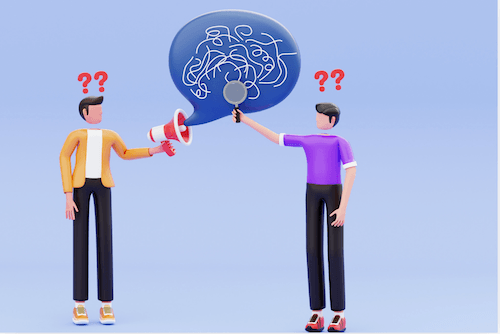
“Garbled” is how Alyssa used to describe her communications with fiancé Jackson.
Consider the time she greeted him at the front door with a warm smile and a kiss—and noticed fresh mud on his shoes. She gently asked Jackson to please leave his boots on the stairs.
Puzzled, he replied, “Your suits stare? Huh? What do you mean?”
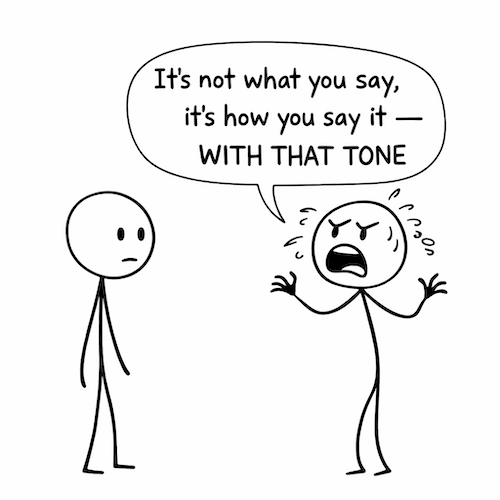
Despite Alyssa’s clarification, Jackson remained convinced that she had said exactly that. Moreover, she’d said it with that tone—the disapproving kind.
This wasn’t their first tangled conversation. In fact, it happened so often that Alyssa asked Jackson to get his hearing checked. The results came back normal.
Their couple therapist suggested something else: Perhaps Jackson harbored deep psychological resistance to listening to Alyssa and was subconsciously blocking her out. He was simply tired of being “nagged”.
Sure, she had to remind Jackson a lot to follow through on tasks. But this was something entirely different.
“It’s not that he wasn’t listening,” she said. “He was looking right at me, paying attention. But the message somehow got sliced and diced on the way from my mouth to his understanding of what I’d said.”

With ADHD Diagnosis Came Understanding—and Strategies
Fortunately, Jackson’s ADHD diagnosis came just as these miscommunications had reached a fever pitch.
When they later attended my conference presentation, they told me they felt enormous relief learning that ADHD has a common traveling companion called Central Auditory Processing Disorder (CAPD). In fact, we could even call CAPD a common side effect of ADHD.
Briefly, CAPD can cause a person to misinterpret both the content of what they hear and, at times, the tone of voice. But here’s what most people don’t understand: CAPD is typically not a separate condition. Rather, it can be part of ADHD neurobiology. For that reason, treatment often improves CAPD.
We’ll get back to that point in a minute.
Don’t Confuse Poor Executive Functioning With Poor Communication
First, let’s clear up a common misunderstanding. Many partners of adults with ADHD see “communication problems” where the real problem is poor executive functioning.
For example, one partner says, “We need to leave by 7:00 p.m. sharp to get to the event on time.” The ADHD partner agrees. Yet at 6:59, instead of being ready to leave, she is organizing the utility drawer.
The communication was clear. The difficulty is with executive functions such as time management, prioritizing, and shifting attention.
I wrote about this phenomenon: Why Telling Your ADHD Partner ‘You’re Hurting Me’ Isn’t Helping.”
Stress And Implying Motive Worsens Communication
The stress of knowing that communication is going badly can also make things worse for the adult with ADHD—especially when the conversation involves interpersonal issues.
My friend Carl says he relates profoundly to this dynamic. He and his wife were both diagnosed with ADHD eight years ago. Dual-ADHD relationships bring their own particular challenges. Carl explained it to me this way:
With stress, many of us with ADHD get “brain lock.” We realize there’s no hope of expressing ourselves and having a real conversation the way we want. So we frantically search for something to say to make it go away, because we can’t express what we’re really feeling. We can’t even define or focus on what we’re feeling—let alone talk about it.
Then there’s my friend Mary, heartbroken about her marriage to hew newly diagnosed (but not happy about it) husband:
I just don’t know how to talk to my husband anymore. If we make an agreement, he forgets it or complains about it, makes an excuse to break it, or accuses me of remembering it incorrectly.
Disentangling the Poor Communications Ball o’ Yarn
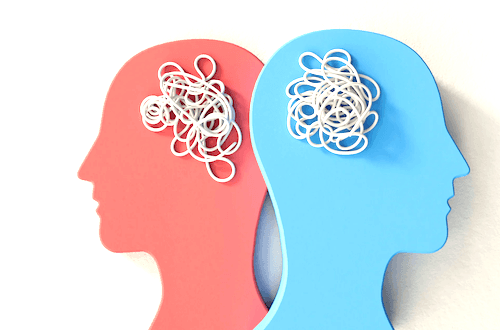
When you’re first navigating an unrecognized ADHD-affected relationship, it can be hard to sort out what’s happening.
- How much is miscommunication?
- How much is personality?
- How much is relationship dynamics?
It can feel completely head-spinning.
Mary’s husband also complains about the “tone” in her voice—even though Mary insists there is no tone. Yet, we might see a neurobiological reason why she might be right—and he might be right, too.
How the Brain Actually “Hears” Words
“There’s no tiny speaker inside your brain that relays messages from the outside,” explains pediatric neurologist Martin Kutscher, author of Kids in the Syndrome Mix of ADHD, LD, Asperger’s, Tourette’s, Bipolar, and More!
What we think we “hear” is actually a kind of virtual reconstruction. Here is what happens, roughly:
- The speaker’s vocal cords produce vibrations that travel invisibly through the air and reach the listener’s eardrums.
- The eardrums vibrate, moving three tiny bones that stimulate the cochlear nerve. At that point, the actual “sound” effectively ends.
- From there, what we experience as hearing becomes a series of silent electrical signals traveling through neural pathways.
- The brain must convert those signals into sounds, convert sounds into words, and convert words into meaningful sentences and ideas.
Most of us do this effortlessly. Which is why we rarely stop to think about how complex the process really is. But when something interferes with that chain of events, the result can be what specialists call Central Auditory Processing Disorder (CAPD).
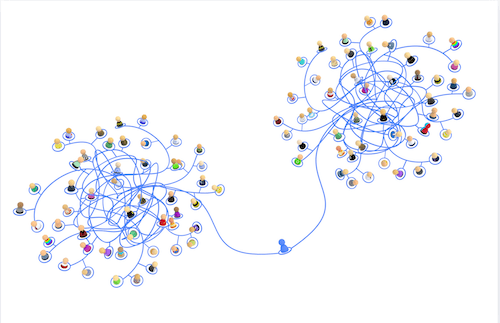
ADHD or Central Auditory Processing Disorder?
For decades, CAPD has been most often discussed in children. The terms originate primarily in the speech-and-language field. And that might explain why mostly children have been diagnosed with it. A friend who just completed her degree in speech therapy as a prestigious school tells me this, “My professor said that CAPD goes away by age 12.”
Psychologists and psychiatrists, however, seldom use the term. Moreover, if they do, they don’t always realize it can be a “downstream” effect of ADHD, rather than a separate condition.
My reading of the literature suggests that this may sometimes represent a kind of discipline bias. In other words, similar symptoms may be interpreted differently depending on the professional lens through which they are viewed. As a result, in some settings the diagnosis becomes CAPD. In others, it becomes ADHD.
Why does this distinction matter? Because treatment approaches can differ—and some studies suggest that methylphenidate can improve CAPD symptoms.
CAPD Typical Characteristics:
Consider the typical characteristics of CAPD described by the National Institute on Deafness and Other Communication Disorders. Individuals may:
- Have trouble paying attention to and remembering information presented orally
- Struggle with multi-step directions
- Show poor listening skills
- Need more time to process information
- Experience academic or behavioral difficulties
- Confuse syllable sequences or struggle with vocabulary and language comprehension
- Have difficulty with reading, comprehension, spelling, or vocabulary
As you can see, the overlap with ADHD is hard to ignore.
One review paper summarized the issue bluntly: whether a child receives the diagnosis of CAPD or ADHD may depend on whether an audiologist or a psychologist evaluates the child first.
Adults with these listening challenges may never receive either diagnosis. Instead, they may be labeled passive-aggressive, oppositional, argumentative, or withholding. Or simply a “poor communicator”.
Later in life, they may be evaluated for hearing loss and fitted with hearing aids. But their hearing might be perfectly fine. Their listening might be the real challenge.
Why “Tone of Voice” Gets Misinterpreted
Functional SPECT brain imaging suggests another factor.
Clinical neuroscientist Charles Parker, DO, notes that auditory processing challenges often involve the right temporal lobe—the region associated with interpreting tone and intonation, recognizing facial expressions, and appreciating rhythm and music.
Parker describes an Olympic skier who suffered a concussion during a practice run. Imaging later showed diminished function in the right temporal lobe.
The athlete insisted nothing was wrong—even as communication problems with his wife and colleagues became obvious. After reviewing the scan, Parker told him, “You are the kind of guy who doesn’t get it—and doesn’t admit he doesn’t get it.”
The patient immediately replied, “No, I get it.”
Parker pointed out that the patient had just illustrated the very problem he denied.
His wife chimed in: “This is what happens all the time.”
One needn’t suffer a brain injury to experience this type of difficulty. Parker notes that diminished temporal-lobe function can also result from a variety of factors, including sleep medications, toxin exposure, and other neurological stressors.
When combined with ADHD, these challenges can significantly complicate communication.
ADHD Traits Can Trigger Poor Communication
Before latching onto a CAPD diagnosis, it’s critical to remember: Core ADHD symptoms can make communication harder.
Distractibility, inattention, and weak working memory can all interfere with a person’s ability to track what is being said. To tell stories in order. To use names for the various characters involved instead of a ubiquitous “she” or “he”.
I once saw a vivid demonstration of working memory during a lecture by a psychiatrist who both treats ADHD and has ADHD himself.
He began by asking everyone diagnosed with—or suspecting—ADHD to raise their hands. Nearly the entire audience of about twenty-five people did.
Then he recited a short biography:
My name is John Michael Smith. I grew up in Philadelphia. I attended medical school at UCLA. Now I live in Palo Alto.
Moments later he asked, “Who remembers my middle name?” Two hands went up.
“Where did I attend medical school?” One hand.
“Where do I live?” Six hands shot up. (That was easy because the meeting was held in that city, Palo Alto.)
“Where did I grow up?” Two tentative hands.
His conclusion: When people think they’re having communication problems, they may actually be struggling to remember details from one sentence to the next.

Communication Strategies for ADHD Relationships
For some couples, practical strategies alone can improve communication. These suggestions come from my book Is It You, Me, or Adult ADHD?
Partners of adults with ADHD:
- Turn off distracting noises before speaking.
- Touch your partner and make eye contact before beginning.
- Ask your partner to repeat what you said to ensure understanding.
- Speak simply and concisely when possible.
- Avoid discussing important matters “on the fly.”
For adults with ADHD:
- Recognize that attentive listening communicates respect and care.
- Listen first, respond second.
- Set aside unrelated thoughts while your partner is speaking.
- If you need time to formulate a response, say so.
- Use relaxation techniques before important conversations.
Couples:
- For some discussions, email works better than face-to-face conversation.
- Take a walk together when discussing difficult topics; exercise increases blood flow to the brain and reduces stress.
- Recognize that eye contact can sometimes distract rather than help listening.
- Use a whiteboard or shared system for key household reminders.

Rx: When Strategies Aren’t Enough
To be clear: Strategies such as getting a person’s attention before speaking can help—but they may not fully solve the problem. More likely, they are best used with medication as part of comprehensive ADHD treatment.
As Jackson and Alyssa discovered, medication can sometimes make a significant difference.
Stimulant medication can strengthen the brain’s ability to transmit and interpret signals, helping the person pay attention to what is being said.
Consider these examples.
Janine says:
My boyfriend has been taking stimulant medication for about a month now. The biggest difference is that we can discuss things without emotional explosions. He used to lose the thread quickly and go off on tangents. Now we actually finish conversations.
David reported something similar:
Communication between my wife and me changed dramatically after she began medication. Previously she could remember details but still miss the intent of the conversation. Now she listens and can discuss differences without immediate conflict.
He added one practical observation:
I still avoid serious discussions after about 8 p.m.—when the medication wears off and misunderstandings start creeping back in again.
The Bottom Line on ADHD and Miscommunication
When conversations repeatedly go sideways in an ADHD-affected relationship, it’s easy for both partners to reach painful conclusions.
One partner may assume the other isn’t listening, doesn’t care, or is deliberately distorting what was said. The other may feel constantly accused, confused, even interrogated, and increasingly reluctant to engage in difficult conversations.
Over time, these misunderstandings can erode trust and goodwill on both sides. Communication grows worse and the relationship more troubled.
Let’s remember: The problem is not always psychological or relational. It may reflect differences in how the brain processes and interprets spoken language.
Auditory processing challenges, working-memory limitations, distractibility, and emotional stress can all interfere with how messages travel from one person’s mouth to another person’s understanding.
That doesn’t mean every conflict in an ADHD relationship stems from these factors. Couples still face the usual human challenges of personality differences, habits, and emotional baggage.
But recognizing the possible neurological contributors can be enormously relieving.
Instead of assuming bad motives, couples can begin asking different questions:
- Was the message actually heard and processed?
- Did working memory drop part of the information?
- Did tone or meaning get misinterpreted along the way?
- Are stress or ADHD symptoms amplifying the problem?
- Is medication in effect during times of interaction?
From there, couples can begin experimenting with strategies that strengthen communication — from reducing distractions to clarifying agreements in writing to exploring appropriate treatment for ADHD itself.
For many couples, simply understanding what might be happening inside the brain can be the first step toward calmer, clearer conversations — and far fewer “garbled” ones.
As always, I welcome your comments and questions.
—Gina Pera

8 thoughts on “ADHD Relationships and “Miscommunication”?”
Oh man…this is soooo us! Especially this part:
“The other may feel constantly accused, confused, even interrogated, and increasingly reluctant to engage in difficult conversations. Over time, these misunderstandings can erode trust and goodwill on both sides. Communication grows worse and the relationship more troubled.”
I told my wife (the one with ADHD) yesterday that I’m going to try and focus on my own health & well-being for a bit. Or, in the language of our Christian faith: I’m going back to square one to try and remove any & all logs from my own eye, and not even worry about specks/slivers in others’ eyes. This might seem selfish, as I turn my attention slightly more inward. But, as quoted above, trust & goodwill has been painfully eroded. I feel like I’ve been catching some of these ADHD/CAPD symptoms like one catches a cold.
Thank you for the wealth of information you bring! Sometimes it’s overwhelming to sort through & understand. But, I’ve also been studying several others (Dr. Daniel Amen, Neuron-Connect, Dr. Louisa Nicola, to name a few). Keep up the great work!
Dear L. (I removed your full name from the post, as it is rather unique.)
Thank you so much for letting me know that my work has shed some light for you.
There are so many moving parts to late diagnosis adult ADHD. Made more complicated by the fact that people with ADHD are not clones, and neither other partners.
I created a system to help individuals and couples quickly cut through to the core issues and learn how evidence based strategies can make everyone’s life a lot happier and healthier.
This is the overview page. If you click on each “puzzle piece”, you’ll find sample videos. Those alone can probably answer more than a few few questions for you.
https://ginapera.adhdsuccesstraining.com/
Good luck
Gina
I have adhd and this latest article is way too long. I got through maybe 1 5th of it before I lost interest and gave up. Maybe breaking these articles up into much smaller segments would be helpful. Thanks
Hi Patrick, thanks for your comment.
You know, the Internet is full of one shot little tips and tricks, and I find that there’s a real need for more in-depth, comprehensive look at a complex issue.
You can always read what you like and skip the rest.
Also I’ve convert many blog post into podcast, so that might be easier to take in.
Thanks
Gina
Maybe the fact that you lost interest 1/15th of the way through a short article about something that affects you, indicates that you could improve your attention span, for your own sake? Sounds like medication might improve your life and the lives of those around you.
Stay away from people who live in a different reality because of their neurological issues. Radical self-respect is not mentioned enough, stop being kind to people who are consistently cruel and mean to you. It doesn’t matter why someone is empathy deprived. How much more can one person be asked to understand and accommodate their myriads of deficiencies? If these men want to be considered for even a friendship, they need to do the work themselves but they won’t because they can’t and because they don’t get it and because they don’t see anything wrong with themselves. I might feel sorry for them from afar, but not just yet. Empathy deficient people traumatize others.
Hi Mimi
Thanks for your comment. I definitely hear you.
I do despair of all this “appreciating difference” because it’s laid on so thickly and without any warnings. Sure we can appreciate difference — because we all are different!— but sometimes differences are a difference too far. And they can end up destroying us if we don’t know what we’re up against.
The thing is we’re not just talking about men here. ADHD cuts across the gender spectrum, and the issues are remarkably similar, sometimes filtered through gender stereotypes. But there are also distinct differences among the millions of people with ADHD. As I always say, “no cookie cutters.”
The thing with ADHD and empathy impairments (which isn’t universal, by any means) is that treatment often mitigates the symptoms that can interfere with innate empathy and its expression.
Often, but not always.
Then too, until we understand what exactly we’re dealing with, it’s hard to have empathy for our partners who have ADHD.
Cheers
Gina
“but they won’t because they can’t and because they don’t get it and because they don’t see anything wrong with themselves”
Who’s “they”? Men? People with ADHD? To what end do you come to blog about ADHD just to announce that there is no hope for people with ADHD? That just speaks of some hurt you suffered and still haven’t been able to process